Thoughts of Cyber Security often does not conjure any expectation of human involvement. However, the human machine interface still is the number one entry point – more than 85% of attacks start with the human factor.
COVID has only exacerbated many of the effects and occurrences of Cyber Security threats. As increasingly more of us work from home, the expectation is that we are all able to access any required work system seamlessly from home.
Compounded by the complexity of systems: Hybrid, Cloud, Legacy or a combination thereof the number of organisations that have reported attacks has increased in the last year. Recent research of 1.2K Global IT Leaders have revealed:
■ 51% report business email compromise, up from 42% a year ago.
■ 39% of organizations report insider attacks, up from 27% a year ago.
■ 79% say they’ve encountered ransomware attacks, and 35% admit one or more of those attacks led them to lose access to data and systems.
Additionally, 40% of respondents report a regulatory violation (up from 28% 1 Year ago)
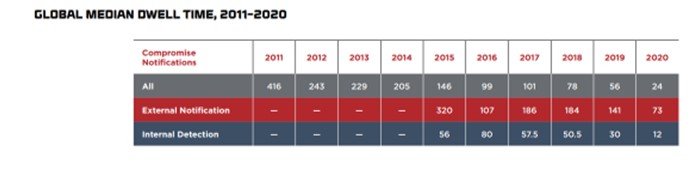
These increases are indeed significant and worrying. Some part of the increase may be a result of better monitoring tools or a result of an actual increase in the number of attacks. Often many organisations do not realise they have been attacked. The period between actual attack and realisation is called the Dwell time. Encouragingly, the Global Median Dwell time is now 24 Days. (M Trends 2022 Report) The dwell time is the time between an attacker’s initial penetration of an organization’s environment and the point at which the organization finds out the attacker is there, it is the window of risk where organisations are extremely vulnerable to attack and has improved through advanced technology solutions.